Last updated 2026-07-27
TL;DR
"Reconstituting" dapsone isn't a real step for FDA-approved products. Topical dapsone (Aczone) comes premixed in a gel or is compounded by a licensed pharmacy; oral dapsone is a solid tablet, not a lyophilized powder. If a source tells you to mix dapsone powder with water or a diluent yourself, that's a sourcing red flag, not a legitimate protocol.
what does "reconstitute" actually mean, and does it apply to dapsone?
Reconstitution is the process of adding a liquid, usually sterile water or a specific diluent, to a lyophilized (freeze-dried) powder to turn it into an injectable or usable solution. It's standard for things like certain antibiotics, insulin products, and peptide vials that ship as powder to preserve shelf life. Dapsone doesn't come this way. FDA-approved dapsone exists in two forms: oral tablets (25 mg and 100 mg, brand name and generic) and topical gel (Aczone, 5% and 7.5%) [1]. Neither is a lyophilized powder that a patient reconstitutes at home. Oral tablets are swallowed as manufactured. Topical gel comes premixed in a tube or pump, ready to apply. If you've landed here because someone told you to "reconstitute" a dapsone powder or vial, you're most likely dealing with a compounded or gray-market product, not an FDA-approved one. That distinction matters a lot for safety, and we'll walk through why below. For people specifically asking about dosing math and schedules rather than powder prep, the Dapsone Rx dosage and dosage calculator pages cover that ground directly.
is topical dapsone (aczone) something you mix or reconstitute yourself?
No. Aczone 5% and 7.5% gel ship as a finished, stable product. You squeeze it from a tube or pump onto clean, dry skin, roughly a pea-sized amount for the face, once daily [2]. There's no powder, no diluent, and no at-home mixing step at any point. Aczone 7.5% was approved by the FDA in 2016 for once-daily use in patients 12 and older with acne vulgaris, based on two 12-week phase 3 trials showing statistically significant reductions in inflammatory and noninflammatory lesions compared to vehicle gel [2]. The active ingredient sits suspended in the gel base already; the formulation work happened at the manufacturing plant, not on your bathroom counter. Some compounding pharmacies do prepare custom-strength dapsone topical formulations (for people who can't tolerate the commercial gel base, for example). That's a licensed pharmacist compounding a semi-solid preparation under USP standards, not a patient reconstituting a powder. If you're getting a compounded topical dapsone product, the safety question isn't "how do I reconstitute this" but "is this pharmacy licensed and is the formulation being verified for potency and stability."
is oral dapsone reconstituted from a powder?
No, and this is worth being direct about. Oral dapsone is manufactured as a solid tablet (25 mg or 100 mg). It is not sold as an injectable lyophilized powder for patient reconstitution, and there's no legitimate clinical protocol that has a patient mixing dapsone powder with liquid at home. Oral dapsone is a sulfone antibiotic, first developed decades ago, used today for dermatitis herpetiformis, leprosy (Hansen's disease), and certain PCP pneumonia prophylaxis regimens in immunocompromised patients [3]. It is not an FDA-approved treatment for acne. If a source is selling you oral dapsone, or any oral dapsone-like powder, specifically for acne and telling you to reconstitute it yourself, that's a serious mismatch between the drug's actual approval and its marketed use. Oral dapsone carries real risks that don't exist with the topical form: hemolytic anemia, methemoglobinemia, agranulocytosis, and dapsone hypersensitivity syndrome, a severe reaction with fever, rash, and organ involvement that carries a mortality rate estimated around 9.9% in published case reviews [4]. None of this is a reason to reconstitute anything at home. It's a reason oral dapsone requires physician supervision and lab monitoring, full stop.
why do people even ask about reconstituting dapsone?
A few reasons, and they're worth separating out. First, confusion with other drug classes. Peptides, some antibiotics for injection, and certain biologics do require reconstitution, and dapsone gets lumped in with "research chemical" or performance-enhancement forums where reconstitution is a common topic. Dapsone has no legitimate role in that world; the confusion is a labeling and sourcing issue, not a pharmacology one. Second, gray-market and research-chemical sellers. Some online sellers market "dapsone powder" for research use, sidestepping FDA oversight entirely. These products have no verified purity, sterility, or dosing accuracy. Using one on yourself, reconstituted or not, means you have no idea what's actually in the vial. The FDA's warning on unapproved and misbranded drugs sold online applies squarely here [5]. Third, people confusing dapsone with dosing calculations for legitimate compounded topical formulations, where a pharmacist might describe percentage strength or dilution from a bulk active ingredient. That's a compounding process performed by a licensed pharmacy, governed by USP <795> standards for nonsterile compounding, not a step a patient performs [6].
how is compounded topical dapsone actually prepared by a pharmacy?
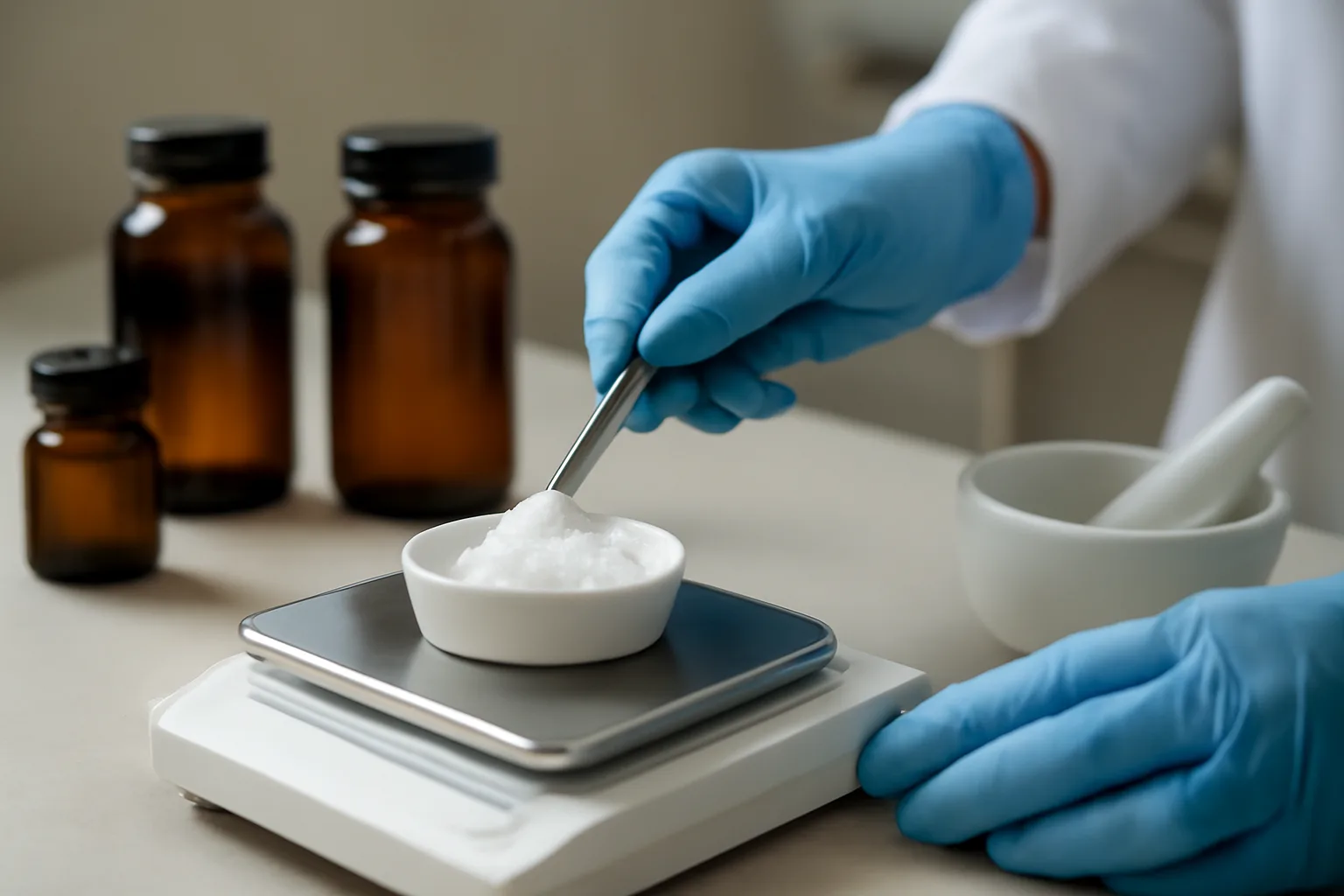
When a dermatologist prescribes a custom-strength or custom-base topical dapsone (say, for a patient who reacts to the commercial gel's excipients), a compounding pharmacy prepares it using pharmaceutical-grade dapsone powder mixed into a gel, cream, or ointment base under controlled, verified conditions. This is not the same activity as a patient reconstituting a vial. The pharmacy weighs the active ingredient on calibrated equipment, follows a validated formula (often from a compendium like USP-NF or a documented in-house formulation), and is required under USP <795> to verify beyond-use dating and stability for nonsterile preparations [6]. State boards of pharmacy inspect and license these facilities. If you're prescribed a compounded dapsone product, the questions worth asking your pharmacy are: What's the beyond-use date? What base is being used? Is this pharmacy accredited (many patients look for PCAB accreditation)? None of this involves you doing any mixing.
what's the actual difference between topical and oral dapsone for acne?
This is the distinction that matters most, and it's easy to blur if you're skimming.
| Feature | Topical dapsone (Aczone) | Oral dapsone |
|---|---|---|
| FDA-approved for acne | Yes, 5% and 7.5% gel [2] | No |
| Requires G6PD testing | Not routinely required [2] | Yes, before starting |
| Main risks | Local skin irritation, mild peeling | Hemolysis, methemoglobinemia, agranulocytosis, hypersensitivity syndrome [4] |
| Systemic absorption | Minimal | Full, systemic drug levels |
| Typical monitoring | None routine | Baseline and periodic CBC, G6PD status, liver function |
The topical gel is designed to keep the drug local, at the skin surface, so systemic absorption is low and G6PD-related hemolysis risk is much lower than with the oral form [2]. Oral dapsone is absorbed fully into the bloodstream, which is exactly why it can treat systemic conditions like dermatitis herpetiformis, and exactly why it carries the systemic risk profile topical dapsone doesn't.
why does g6pd status matter so much for oral dapsone?
Dapsone's major metabolite (via CYP-mediated N-hydroxylation) is a strong oxidizing agent that stresses red blood cells. In people with glucose-6-phosphate dehydrogenase (G6PD) deficiency, red cells can't regenerate the antioxidant reserves fast enough, leading to hemolytic anemia that can be severe. The FDA label for oral dapsone tablets states that patients should be tested for G6PD deficiency before starting therapy, and that hemolysis, sometimes severe, is expected to some degree in most patients on oral dapsone, with the degree of hemolysis heavily dependent on the dose and on G6PD status . This isn't a rare footnote risk. It's baseline pharmacology. G6PD deficiency affects an estimated 4.9% of the global population, according to a widely cited genetic epidemiology analysis, with much higher prevalence in people of African, Mediterranean, Middle Eastern, and Southeast Asian ancestry . That's not a niche subgroup. Any physician prescribing oral dapsone should order a G6PD screen first, and this is a hard requirement, not a suggestion, for anyone considering oral therapy.
what is dapsone hypersensitivity syndrome, and how does it relate to dosing?
Dapsone hypersensitivity syndrome (DHS) is a severe, rare, delayed drug reaction to oral dapsone, typically appearing 2 to 6 weeks after starting the drug. It presents with fever, a widespread rash, swollen lymph nodes, and organ involvement, most often hepatitis. A systematic review of published cases found DHS carries a mortality rate around 9.9%, and it's not clearly dose-dependent in the way hemolysis is; it can occur even at standard therapeutic doses [4]. This is one of the sharpest reasons oral dapsone isn't something to self-manage or dose-adjust without physician oversight, and it's part of why cycle length and titration schedules for oral dapsone need real clinical supervision, covered in more detail on the Dapsone Rx cycle length page. None of this applies meaningfully to topical Aczone, where systemic drug levels stay low enough that DHS and hemolysis are not the primary concern; local irritation is.
how should you actually apply topical dapsone, if not "reconstitute" it?
Application is simple and doesn't involve any prep step. Wash and dry the affected area, apply a thin layer of gel (about a pea-sized amount for the whole face) once daily, and let it absorb before applying other products or makeup [2]. The 7.5% formulation is approved for once-daily use; the older 5% formulation was originally approved for twice-daily use. Mild, temporary orange-ish discoloration can occur if benzoyl peroxide is applied to the same area at the same time; that's a known cosmetic interaction, not a safety issue, and staggering application (one product in the morning, one at night) avoids it [2]. There's no loading dose, no titration curve, and no reconstitution math for topical dapsone. If you want the specific numbers on how much to use and how often, that's covered directly on the Dapsone Rx dosage page and the dosage calculator.
if oral dapsone isn't reconstituted, how is it dosed and adjusted?
Oral dapsone for approved indications (dermatitis herpetiformis, leprosy, PCP prophylaxis) is dosed in milligrams by tablet, typically starting low and titrating based on response and lab monitoring, not by any powder-mixing step. For dermatitis herpetiformis, adult doses often start around 50 mg daily and are adjusted based on symptom control and tolerability, under a physician's guidance, with regular blood counts to watch for hemolysis and, less commonly, agranulocytosis [3] . Injectable forms and home-administered protocols (the kind that would ever involve reconstitution) are not part of standard dapsone therapy. If you've seen injection-related content about dapsone, including on pages like how to inject or injection sites, those describe unrelated injectable medication categories or entirely different, non-FDA-approved products; oral and topical dapsone are not injectable drugs by design or approval. Anyone considering oral dapsone should also understand its clearance timeline, since the drug's elimination half-life (commonly cited around 20 to 30 hours, with wide individual variation) affects how long side effects and monitoring windows extend after a dose change; details are on the Dapsone Rx half life page.
where should you actually get dapsone, and how do you avoid gray-market risk?
Get it from a licensed pharmacy on a valid prescription, whether that's the FDA-approved Aczone gel from a retail pharmacy or, for oral dapsone, a prescription filled by a licensed pharmacy after appropriate lab screening. Avoid any seller offering "dapsone powder" for reconstitution, research use, or unspecified purposes. These products bypass FDA manufacturing oversight entirely, meaning there's no guarantee of purity, correct labeling, or even that the vial contains dapsone at all. The FDA has repeatedly flagged unapproved online drug sellers for exactly this kind of risk [5]. Dapsone Rx works with a provider-reviewed model: a licensed provider evaluates whether topical or oral dapsone is appropriate, orders G6PD screening when oral therapy is on the table, and prescriptions are filled through a licensed fulfilling pharmacy partner, not a self-mix vial. That's the entire distinction that matters: prescription plus pharmacy dispensing, not powder plus home reconstitution.
what should you ask your doctor before starting either form?
For topical Aczone: ask whether your acne pattern (inflammatory vs. comedonal) is a good match, and whether combining it with a retinoid or benzoyl peroxide makes sense for your skin. Topical dapsone generally doesn't require G6PD testing given its low systemic absorption [2]. For oral dapsone: ask directly whether you've been screened for G6PD deficiency, what your baseline CBC and liver panel show, and how often you'll be monitored once therapy starts. Ask what symptoms (fever, rash, unusual fatigue, blue-tinged skin from methemoglobinemia) should trigger an immediate call, not a wait-and-see approach. In both cases, ask why oral dapsone specifically is being considered for acne at all, since it isn't an FDA-approved use, and any off-label prescribing for acne should come with a clear clinical rationale, not a default assumption that oral is just a stronger version of topical.
Frequently asked questions
Do I need to reconstitute dapsone gel before using it?
No. Aczone (dapsone) gel, whether 5% or 7.5%, ships premixed and ready to use. You apply a thin layer directly to clean, dry skin once daily. There's no powder, diluent, or mixing step involved at any point, unlike lyophilized injectable drugs that genuinely require reconstitution.
Is oral dapsone sold as a powder that needs mixing?
No. FDA-approved oral dapsone comes as solid tablets (25 mg or 100 mg), swallowed as manufactured. It is not distributed as a lyophilized powder for patient reconstitution. If you encounter a seller offering dapsone powder for mixing, that's a strong sign of an unapproved, gray-market product outside FDA oversight.
Why do some online sources talk about reconstituting dapsone?
Usually confusion with peptides or injectable antibiotics that do require reconstitution, or gray-market "research chemical" sellers marketing raw dapsone powder outside FDA-approved channels. Neither topical nor oral FDA-approved dapsone involves a reconstitution step, and products marketed that way should be treated as a sourcing red flag.
Is topical dapsone safe for people with G6PD deficiency?
Topical dapsone has minimal systemic absorption, so routine G6PD testing isn't required per the product's prescribing information [2]. Oral dapsone is different: it's fully absorbed systemically and the FDA label specifically calls for G6PD testing before starting oral therapy, since deficient patients face higher hemolysis risk [8].
What is the difference between Aczone and oral dapsone?
Aczone is an FDA-approved topical gel (5% and 7.5%) for acne, with low systemic absorption and mainly local skin side effects. Oral dapsone is a systemic sulfone antibiotic used for dermatitis herpetiformis, leprosy, and PCP prophylaxis, not approved for acne, and carrying risks like hemolysis and hypersensitivity syndrome.
Can oral dapsone be used for acne?
Oral dapsone is not FDA-approved for acne. Some clinicians prescribe it off-label in specific, hard-to-treat cases, but this requires G6PD screening, baseline blood work, and ongoing monitoring given its systemic risk profile. For most people with acne, topical dapsone (Aczone) is the appropriate, FDA-approved option.
What are the signs of dapsone hypersensitivity syndrome?
DHS typically appears 2 to 6 weeks after starting oral dapsone, with fever, a widespread rash, swollen lymph nodes, and organ involvement (commonly hepatitis). Published case reviews put mortality around 9.9% [5]. Anyone on oral dapsone developing fever and rash should contact their prescriber immediately rather than waiting it out.
How is compounded dapsone prepared, if not by patient reconstitution?
A licensed compounding pharmacy weighs pharmaceutical-grade dapsone powder and mixes it into a gel, cream, or ointment base under USP <795> nonsterile compounding standards, with documented formulas and verified beyond-use dating [7]. This is performed entirely by pharmacy staff; patients never handle raw powder or perform any mixing themselves.
What blood tests are needed before starting oral dapsone?
A G6PD deficiency screen is required before starting, since the FDA label warns hemolysis occurs to some degree in most patients and is worse in G6PD-deficient individuals [8]. Baseline complete blood count and liver function tests are also standard, with periodic repeat monitoring during treatment to catch anemia or agranulocytosis early.
How common is G6PD deficiency, and why does it matter for dapsone?
An estimated 4.9% of the global population has G6PD deficiency, per a widely cited genetic prevalence analysis, with much higher rates in people of African, Mediterranean, and Southeast Asian descent [9]. Since oral dapsone's metabolite oxidizes red blood cells, G6PD-deficient patients face substantially higher risk of drug-induced hemolytic anemia.
Does topical dapsone interact with benzoyl peroxide?
Using benzoyl peroxide and topical dapsone on the same skin at the same time can cause temporary yellow-orange discoloration, a cosmetic effect, not a safety issue [2]. Many dermatologists suggest applying one product in the morning and the other at night to avoid the interaction entirely.
Where can I get dapsone safely, topical or oral?
Through a licensed pharmacy on a valid prescription after evaluation by a provider. For oral dapsone, that evaluation should include G6PD screening. Avoid any seller marketing raw dapsone powder for self-mixing or "research use," since those products bypass FDA manufacturing and purity oversight entirely [6].
Sources
- FDA, Drugs@FDA database entry for dapsone products: Dapsone is FDA-approved as oral tablets and as topical gel (Aczone), not as a reconstituted powder
- FDA, Aczone (dapsone) gel 7.5% prescribing information: Application instructions, low systemic absorption, and benzoyl peroxide discoloration interaction for topical dapsone gel
- MedlinePlus, Dapsone (Oral Route): Oral dapsone is used for dermatitis herpetiformis, leprosy, and other conditions, taken as tablets
- Lorenz et al., review of dapsone hypersensitivity syndrome, Journal of Clinical Pharmacy and Therapeutics / case series analyses: Dapsone hypersensitivity syndrome mortality rate estimated around 9.9% in published case reviews
- USP, General Chapter <795> Pharmaceutical Compounding - Nonsterile Preparations: Compounding pharmacies must follow USP <795> standards including verified beyond-use dating for nonsterile preparations like compounded topical dapsone
- Nkhoma et al., G6PD deficiency global prevalence meta-analysis, Blood Cells, Molecules, and Diseases: Estimated 4.9% global prevalence of G6PD deficiency, with higher rates in specific ancestral populations